
Java Trek to Peru - Part 1/3
CRS Fair Trade Ambassador Janet Berna had the opportunity to travel to coffee farms in Peru with CRS Fair Trade partner Dean’s Beans. What follows is a three part reflection series on her travels. You can also view a photo slideshow of her trip here.
As a Fair Trade Ambassador, I am convicted—I tell people that fair trade is not charity; it is justice. I reflected on this as I prepared for my trek to Peru.
Wondering what I was getting myself into, yet excited for the journey ahead, I did my homework for the journey. As I watched the video about the Oro Verde cooperative, and read Java Trekker, by Dean Cycon of Dean’s Beans, I found myself thinking that even with all I know, a part of me felt that the upcoming trip I would take was like a charity mission. My husband Tom commented, “We’re all on the same blue marble.” In this, I felt a sense of humility. The video reminded me that these people have a long history of exploitation by people like me. Before we go, I remained hopeful that the people I meet would come to know me and accept me as I am. I was so excited at the opportunity to be connected to real people—to the people that I have been thinking about when I talk about fair trade, or buy and sell fair trade products!
In our delegation, many of the people were involved with their labor unions in New York. One group uses and sells Deans Beans Fair Trade coffee within the union. A connection with Fair Trade and unions is quite natural, but something that I hadn’t thought of before. We had a great group with a lot of diversity and I left the city of Lima excited for the journey ahead. To get to our first destination we rode in the back of one of the cooperative’s 2 pick-up trucks for 1 ½ hours. It was a thrill a minute and I found myself closing my eyes for some close calls: definitely a stretch for me, but a fun one!
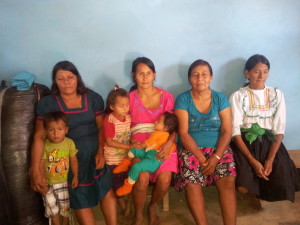
Our first stop was Aviacion, where we met with indigenous coffee farmers. The farmers and their families were proud of the building in the village used as a meeting place for the cooperative.
In Aviacion we walked to Bruno and his wife’s home and coffee farm. They invited us into their home when it started raining. It was a simple home—a large open room filled with coffee bags ready to be transported to market. Bruno’s wife offered us Sacha Inchi nuts, oranges and peanuts.
At Bruno’s farm, most of the coffee cherries had been picked off the trees, as this was the last harvest of the season. Sadly, the coffee plants had a fungus called “coffee rust” so that the quality suffered (they could be sold for only $.55 or $.60/pound, rather than the $1.40 /pound they would get for high quality fair trade coffee). A co-op member named Pablo remarked that the harvest this year is 50% less than last year (due to the coffee rust and an insects). They need to tear out all the trees and plant new ones because of the coffee rust. We asked how they would survive the next 3 years (it takes 3 years for new coffee trees to produce beans). They said “we grow what we can to sustain our families and we don’t buy new clothes for the kids.”
Yet in Aviacion there was still a sense of hope—of hard work to have a fulfilling life for their families. Even though the coffee trees are doing poorly, because of the coffee rust, I didn’t see depression or hopelessness. Instead I saw innovation and determination. To combat the problem the farmers were increasing their crops of oil, trees and nuts. I saw that being part of the cooperative is building hope—not just because of the social premium (money) but also because of the relationships and the building of a larger community. In their structure, the farmers elect a representative for each 10 members of the “committee”. By doing this the farmers are empowered for so many reasons: because they are respected, because they all have something to offer, because they are making a better life for themselves.
Subscribe to the blog to be notified when part 2/3 is posted!

Small growers dominate the production of coffee, especially in Latin American countries such as Peru. Coffee is the fastest expanding fairly traded commodity, and an increasing number of producers are small farmers that own their own land and work in cooperatives. Even the incomes of growers of fair trade coffee beans depend on the market value of coffee where it is consumed, so farmers of fair trade coffee do not necessarily live above the poverty line or get completely fair prices for their commodity.
Fairtrade coffee producers are small family farms organized in cooperatives or associations which the farmers own and govern democratically.