
Coffee in Crisis

Just over 10 years ago, the global coffee market collapsed. The prices farmers earned for their coffee fell to their lowest levels in a generation – less than $0.50 per pound. Sometimes much less. Coffee-growing families saw their incomes halved overnight (or worse) due to market forces beyond their control. Farmers struggled to feed their families. Some gave up on coffee. Others gave up on farming altogether and migrated in search of work. The impacts of the price collapse were so severe that the episode became known simply as “the coffee crisis.”
CRS responded to the coffee crisis in the communities where farmers grow coffee overseas and the communities where they drink it in the United States. In Nicaragua, CRS mounted a humanitarian response to help coffee growers feed their families and stay on their farms. In the United States, CRS launched its Fair Trade Coffee Project to enlist U.S. Catholics in the effort to support small-scale family farmers through the purchase of Fair Trade coffee. For more than 10 years, CRS has worked to create new and improved opportunities for the family farmers who grow our coffee through programming in coffee communities overseas and the promotion of Fair Trade and sustainable coffees in the United States.
Today, the coffee sector is in crisis again. 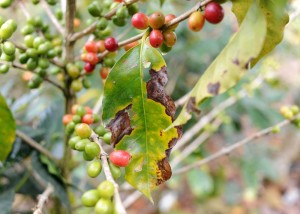 This time the crisis is driven not by what is happening in the marketplace, but by what is happening in the field. Coffee leaf rust, a fungus from the same family of “rusts” that affect U.S. staple crops like corn and wheat, has reached epidemic proportions in Central America. As much as 70 percent of Central America’s coffee fields are affected. Production losses for this harvest exceed 100 million pounds. Farmers have lost hundreds of millions of dollars in revenues due to low production. And hundreds of thousands of jobs have been lost as there is less coffee to pick, process and export. Estimates of missed revenues are well into the hundreds of millions of dollars.
The humanitarian impacts of the coffee rust epidemic on vulnerable farm families are still not entirely understood. Farmers still have money they earned during the recent harvest, but we know from our experience in the field – and from research conducted by our field partners Green Mountain Coffee Roasters and the International Center for Tropical Agriculture – that money doesn’t last long. Coffee-growing families quickly settle into the long lean season between the coffee and staple crop harvests, when cash flows slow to a trickle and families routinely cope with food scarcity. The early indications are that we will not see famine or acute suffering this year, but with official data suggesting that coffee rust could have twice the impact next harvest, I worry that we may be watching a humanitarian crisis unfold in slow motion.
This week, I will be representing CRS during four days of meetings with a broad range of actors – national governments, research institutes, coffee roasters, non-profit agencies, banks, coffee certifiers and others – trying to develop a strategy for coordinated action to mitigate the negative impacts of the current crisis and help vulnerable family farmers prepare for the next one.
In preparation for the meetings, I have been reflecting on the idea of crisis, trying to remember that challenges and opportunities are two sides of the same coin. The last crisis caused a lot of suffering in the coffeelands, but it also created opportunities. It awakened many actors to the social and economic realities of life in the coffeelands – not just coffee consumers, but even importers and roasters who were engaged in the trade but perhaps didn’t fully understand the challenges a small-scale farming family faces. It catalyzed innovation, unleashing a wave of creative initiatives to make the coffee trade more sustainable. It drove the phenomenal growth of the U.S. Fair Trade market, as roasters and consumers sought opportunities to be part of the solution through purchases that generated more benefits for farmers and their communities.
Before the current crisis, we had already begun to recognize the shortcomings of the leading approaches to sustainable coffee. My hope is that a new generation of leaders in coffee will rise to the challenge of the current crisis to create a new wave of opportunities for small-scale coffee farmers and their families.
Guest post by Michael Sheridan, author of the CRS Coffeelands Blog. For more detailed analysis of the coffee leaf rust (La Roya) epidemic and the ways CRS is working to respond, visit http://coffeelands.crs.org/.

If each and every missioner who goes from North America to Honduras on mission were to buy and bring back his or her quota of coffee (100lbs) directly from a farmer, with processing and roasting supervised by a parish priest, could this help?
North Americans could make parish-to-parish fair trade vacations-going down to Honduras on mission/vacation and paying directly for coffee, cigars, and mahogany, rather than simply going down laden with used clothing and medical supplies and coming back empty handed. (Why waste the luggage space already paid for?)
In my time in Honduras 2003-2004, it seemed that missions were a real growth industry there,….why not use this pipeline of people for micro-trade?
If parish priests in Hondurs were the focal point of parish-to-parish vacations, it could also invigorate the Church in Honduras.
Hi Ann,
The idea of micro-trade is a great expression of our Catholic values as it really establishes right relationships and helps folks live in solidarity with the marginalized. Indeed, fair trade as we know it know in the US began decades ago with Edna Ruth Byler doing something very similar after a trip to Puerto Rico. If you already have an existing pipeline for Honduran coffee in this manner, we would certainly encourage you to continue what you’re doing.
However, from a long-term development perspective, a model like this would be hard to “scale-up” and doesn’t address some of the root issues (why, for example, do we even need to buy coffee in this manner - what other factors like food security and right to organize are lacking that would make this need exist at all?). As a development agency with 70 years of experience in work like agriculture and livelihoods (http://crs.org/70th/) those are questions we’d want to ask before undertaking a one-off model like this.
Through our current work, we rely on our network of 15 fair trade partners, all of whom are fully committed not only to paying a premium for the coffee they import, but also to community development and training projects that help coffee farmers thrive.
If you have any questions about how our model relates to what you’re proposing, I’d be happy to elaborate further. Feel free to shoot me an email or give me a call at any time!
Thanks,
Courtney
[email protected]
410.951.7301
What can be done. I hope that the USDA will delay implementing this decision until it has had a chance to more carefully consider its likely impact on farmers overseas and consumers here in the United States . I am also hopeful that the USDA can work with farmers’ organizations and NGOs to strengthen the internal control systems that grower groups use rather that doing away with them altogether. Industry leaders and NGOs representing both consumers and farmers will be coming to Washington in early May to meet with USDA leadership and Capitol Hill allies on this issue. If they can craft some language that advances these goals, we will let you know how you might lobby your representatives in Washington to support it.
Nothing reminds us of the importance of the work that we do like a visit with the farmers. While each cooperative has developed unique organizational structures and methods of operation – the message expressed to visiting fair trade partners is the same. The farmers of CECOCAFEN, COOCAFE, Maya Vinic, Mut Vitz, Apecaform and all of the other cooperatives that we support critically depend on fair trade partnerships in the face of unprecedented low coffee prices. We returned from our recent visit inspired by the enthusiasm and commitment which is so evident at each coop – even as the farmers enter the third year of the coffee crisis. We thank the readers of Fair Grounds for your continued support of Café Campesino. We exist because of you and your conscious decision to purchase fair trade coffee.
I am wondering if pesticides have been routinely used in these coffee fields, notably Monsanto Corporation’s products — or if the coffee fields are adjacent to areas where Monsanto’s genetically modified crops (GMO’s) are being grown. Though I am no farmer, I have followed enough literature on organics vs. agribusiness techniques to guess that the latter may be affecting the coffee harvest.
I am a longtime supporter of CRS, as the Daughters of Wisdom in Madagascar praised your work there. I do hope you teach organic practices in the countries where you work.
Be assured of my prayers for these farmers.
Sr. Laura Algiere,DW
Thank you for your comment, Sr. Laura! First and foremost, for a fair trade product to be certified, they must be GMO-free. Second, the cruel irony of coffee leaf rust is that it often affects organic farmers more than conventional ones. There are chemical fungicides that can slow the spread of the disease, but to maintain organic certification, farmers can’t use them, and they are forced to choose between maintaining their organic status, or using chemicals.
As there is limited space in the comments section, I’d encourage you to check out the CRS Coffeelands blog for more on what we’re doing in response to coffee leaf rust, as well as an overview of the work we do with farmers in the field!
http://coffeelands.crs.org/tag/coffee-leaf-rust/