
Helping Haitian Coffee Thrive

Haiti is a small place - about the size of Maryland. Plus, much of it is vertical. Mountains aren’t great for most agriculture, but they’re ideal for coffee growing. Three hundred years ago, French Jesuits brought coffee trees to Haiti where plants thrived on mountains under the protective canopies of tropical rainforests for centuries.
In 1950, this small island country was the world’s third largest supplier of coffee, and Beaumont was the cream of the crop. Although Haiti is still home to some of the world’s finest Arabica Typica coffee, the rise and fall of Haitian coffee is attributed to factors beyond the control of impoverished farmers. Since the 50’s, Haiti’s production of coffee in both volume and quality plummeted.
The good news about hitting bottom is there’s only one direction…up.
Singing Rooster, a small nonprofit headquartered in Madison Wisconsin, began working in pre-earthquake Haiti in 2009. Our goals were simple and approach holistic: to alleviate rural poverty with economic development through coffee agriculture. We began partnering with farmer-owned coffee cooperatives to provide farmers direct access to markets. It is through the act of transforming farmer crops into higher valued commodities (roasted coffee) and then selling those products on behalf of farmers that producers are able to earn real money.
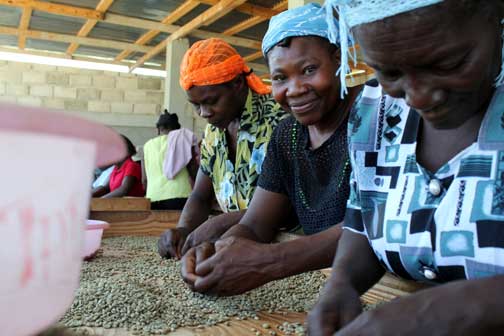
In post-earthquake Haiti, CRS launched its Mountains to Markets program, which opened up amazing opportunities for farmers in the Beaumont region – a once thriving coffee sector. From the beginning, we saw a kindred spirit in CRS whose goals were similar. We began sharing ideas, resources, contacts and coordinating training.
Now in our second year of collaboration, we provide technical support to 3,000 small-scale coffee growers, and this number will double next year. In 2010 farmers managed less than 50% of export quality coffee; by 2012, quality production skyrocketed to 75%. We collaborate to provide training in budget planning and launched preharvest financing programs. Singing Rooster helped to connect Beaumont farmers with another farmer group for final transformation. After 2 years, several thousand pounds have been exported, roasted, and marketed. Proceeds earned from roasted coffee sales are returned to farmer cooperatives for continued economic development.
With growing technical skill, reinvigorated fields and improved processing machinery and facilities, Beaumont farmers are well positioned to produce vast amounts of export-quality coffee. It seems fitting to end with the slogan that defines us: Drink our Coffee. Build an Economy. Pass it on.
Guest Post by Molly Nicaise, Co-founder and CEO of Singing Rooster

Each time I hear a story like this one, I can’t help to get emotional. It’s so nice to see that with hard work and some help, companies can grow.
This story is even better because of the economic and political situation of Haiti. I can’t believe that they could grow so much, I thougth their country was a total chaos.
Anyway, thanks for sharing this!
Cheers.