
More deaths in Bangladesh: How do we respond?
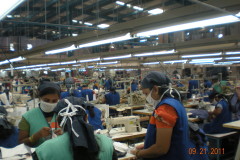
Photo By: J. DeCarlo/CRS
Since the latest news of tragedy following tragedy in Bangladesh-first a factory collapse killing 1127, then an all too familiar fire trapping workers-Courtney and I have been receiving request after request from constituents. What does CRS Fair Trade suggest that consumers do?
For several years now, CRS has been working with NGO allies and socially responsible businesses to try to determine the right standards for wages and working conditions in the garment industry. Making sure that workers are not forced to labor in a building with structural damage like those who died in the building collapse, or that fire exits and other basic safety mechanisms are in place both seem like proverbial no-brainers.
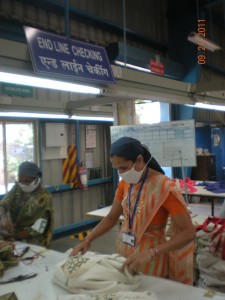
Still, since the Triangle Shirtwaist Factory fire on our own soil more than a century ago, safe and decent working conditions have been a point of contention. Some brands say they are not responsible for the facilities of their subcontractors. They also look to governments of developing countries to enforce building codes or decent wage laws.
But the responsibility for protecting human dignity doesn’t rest only with businesses, or even governments. Fair trade consumers and sweatfree advocates know there is more that can be done. While we have been encouraged by recent corporate pledges to initiatives such as the Bangladesh Factory Safety Plan, this time I want to press for even more from you, the consumer. I don’t think in these kinds of situations it is enough for us just to be conscientious about where are t-shirts come from. We have to take the wake up calls in Bangladesh as a chance not only to honor the lives of those who died needlessly, but also to look at our own lives honestly. Perhaps it is because I am writing during a trip to Palestine, where I am witnessing bravery and persistence and hope in the midst of dire and disturbing political circumstances. But I feel called to focus not on what companies should be doing, but what more individuals can do.
I’ve been taken with the recently published “Buying into Fair Trade: Culture, Morality, and Consumption” by my long-time fair trade buddy, Dr. Keith Brown of St. Joseph’s University. I will give a review of Keith’s book in a future blog, but I want to highlight his characterization of consumers as falling into three groups: purchasers, conscientious consumers, and promoters.
Keith is certainly not the first to segment consumers, but through his research he makes some eye-opening distinctions. Keith points out that some folks don’t really care about where the things they buy come from, who made them and what the process did to that person or the planet. If you are reading this blog you are probably not just a straight-up “purchaser.” You may be instead a “promoter,” someone who embraces the political and economic potential of shopping responsibly and you “live a fair trade life.”
Most of us, though, fall into the camp of conscientious consumers. We are outraged by what happens in apparel factories. We abhor slave labor in the chocolate industry. And yet, our purchases are riddled with contradictions. I, for example, buy organic from my farmers market whenever I can…unless the price is double that for a conventional product.
However in the face of hundreds of people suffering and dying in deplorable working conditions in unsafe factories, being conscientious is not enough. Sure, we need to buy from responsible companies and we need to promote fair trade, but we also need to take a long hard look at our own daily practices. Do we care more about what is fashionable or what is fair? Truth is, Keith and other researchers demonstrate that most consumers choose “fair” AFTER they make decisions based on price, personal taste and convenience.
I am not condemning that “inconvenient truth,” but I am saying we need to own, in the midst of our calls for boycotts and Facebook postings, our own deliberations as we make our purchases. We need to own those decisions just like we own a rack of clothes in a closet. It doesn’t make us bad people to make compromises and considered choices. However, we must carefully and prayerfully reflect on our habits and commitments as consumers. Our economic choices can have positive-or extremely negative-impacts on people we will never meet, and we owe it to them to push ourselves to be more than just conscientious consumers.
By Jackie DeCarlo, Economic Justice Program Manager ([email protected])

Educated consumers have a great deal of power in combating labor oppression simply by the items they purchase. Choice in the marketplace allows consumers to express their convictions. Purchasing ethical products is a powerful tool toward promoting conscious consumerism and helping craftspeople like the women of WEAVE. Concerned Americans realize fair trade purchases help build sustainable livelihoods for low-income workers, ward off injustices of labor exploitation in developing countries and add a greater sense of fulfillment to the shopping experience.
Positive buying means favoring ethical products, be they fair trade, cruelty free, organic, recycled, re-used, or produced locally. This option is arguably the most important since it directly supports progressive companies .
Over the years the fair trade movement has brought third world problems to the first world consumer’s attention. Yet, when it first started off fair trade was mainly a small grass roots campaign. Today, with the establishment of FLO (Fair Trade Organization), fair trade has entered the mainstream market and in many ways has brought fair trade away from its initial concerns. In other words, FLO has limited its mandates/goals to fit the agenda of large business. Meeting only the minimum standard required for a fair trade label in order to attract conscientious consumers many companies do so as a way to tap into alternative markets. Nonetheless, grass roots organizations have remained true to the cause. Alternative Organizations like Grounds for Change and Coffee Direct have been able to do so through establishing cooperatives that bring farmers together. Unfortunately though, they only account for 3% of the world’s coffee farmers.
Educated consumers have a great deal of power in combating labor oppression simply by the items they purchase. Choice in the marketplace allows consumers to express their convictions. Purchasing ethical products is a powerful tool toward promoting conscious consumerism and helping craftspeople like the women of WEAVE. Concerned Americans realize fair trade purchases help build sustainable livelihoods for low-income workers, ward off injustices of labor exploitation in developing countries and add a greater sense of fulfillment to the shopping experience.
The FFP brings together farmworkers, growers, consumers, and eleven multi-billion dollar retail food leaders (including Publix competitors Whole Foods and Trader Joe’s) in support of fair wages and humane labor standards for tomato harvesters. Despite the FFP’s unprecedented success in bringing about long-overdue labor reforms in Florida’s $500-million tomato industry, Publix, one of the largest purchasers of Florida tomatoes, refuses to support the program and continues to buy tomatoes from the handful of Florida growers where workers are denied access to the FFP’s higher standards, complaint mechanism, and “penny-per-pound” bonus.
Jackie, thank you very much for this thoughtful essay. I do indeed find it hard to change my behavior, to keep it in line consistently in line with my values, so I very much appreciate your reflections on the challenge.
Trade as One, like any trading company, therefore incorporates these overhead costs into the profit margin. This margin enables us to operate and grow each year. This means we are able to rent warehouse space, to import products, to employ staff, to cover the costs of bringing the concept of fair trade products to more people each year, and to re-invest in growth.
Thanks for a very thoughtful response to a string of tragic events.
The Fair Trade Federation shared its thoughts, too: http://www.fairtradefederation.org/fair-traders-support-a-refocus-on-relationships/
Thanks for supporting fair trade principles in the work that you do!
And this is why Jackie DeCarlo remains the voice of reason in an ever changing and challenging marketplace. Thank you Jackie!